
A Stone Guestbook of the Ages
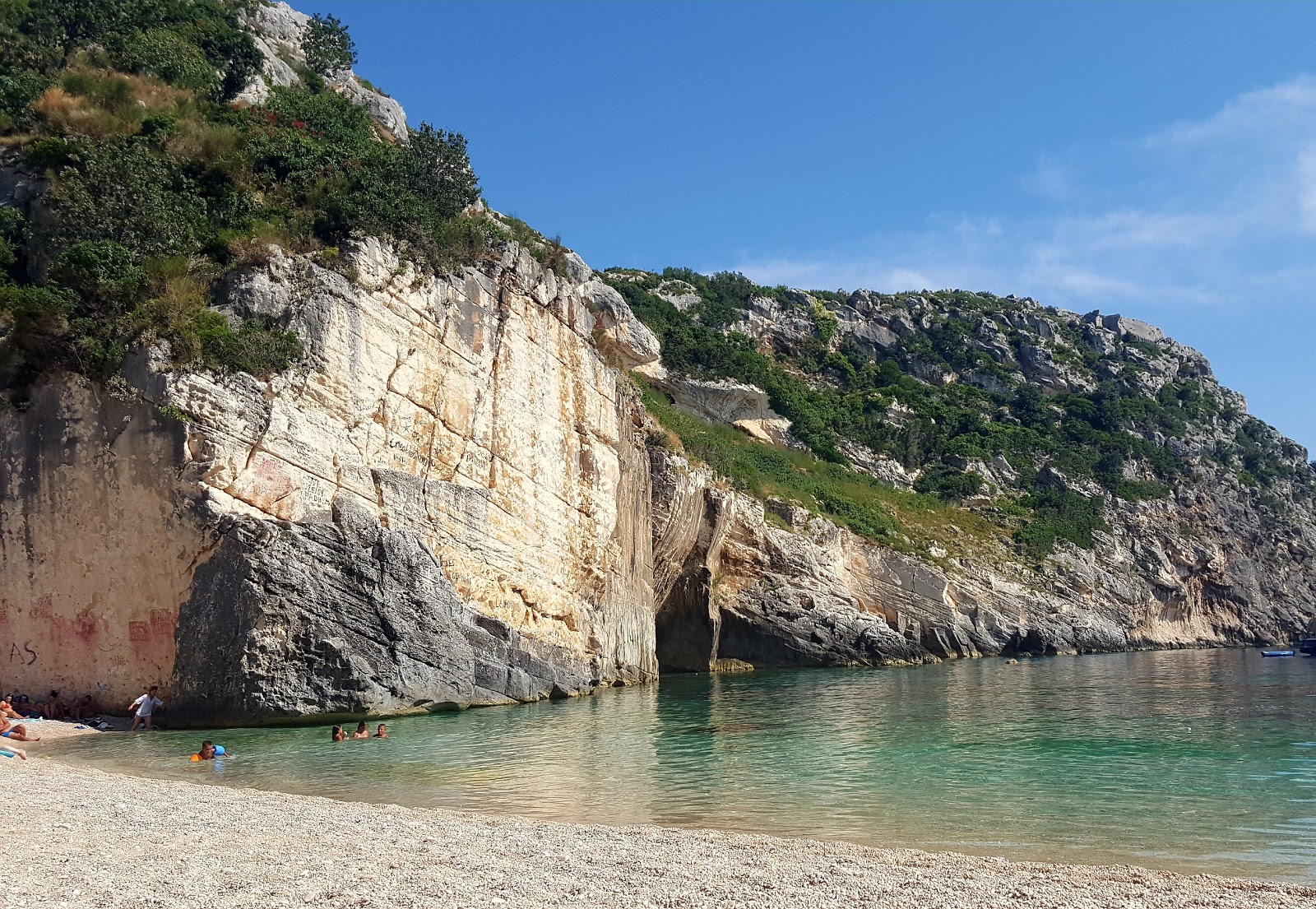
Grama Bay earns its name from the Greek word for ‘writing’ or ‘word’, and once you arrive, you’ll see why. For over two millennia, this secluded cove has served as a natural guestbook for seafarers seeking shelter.
The bay’s sheer rock walls, which make this sanctuary possible, are actually man-made. In antiquity, they were vast quarries, with stone likely being taken for major building works in ancient cities like Orikum or even floated inland to Apollonia. This difficult work left behind the smooth, flat surfaces that countless generations of sailors would use as their canvas.
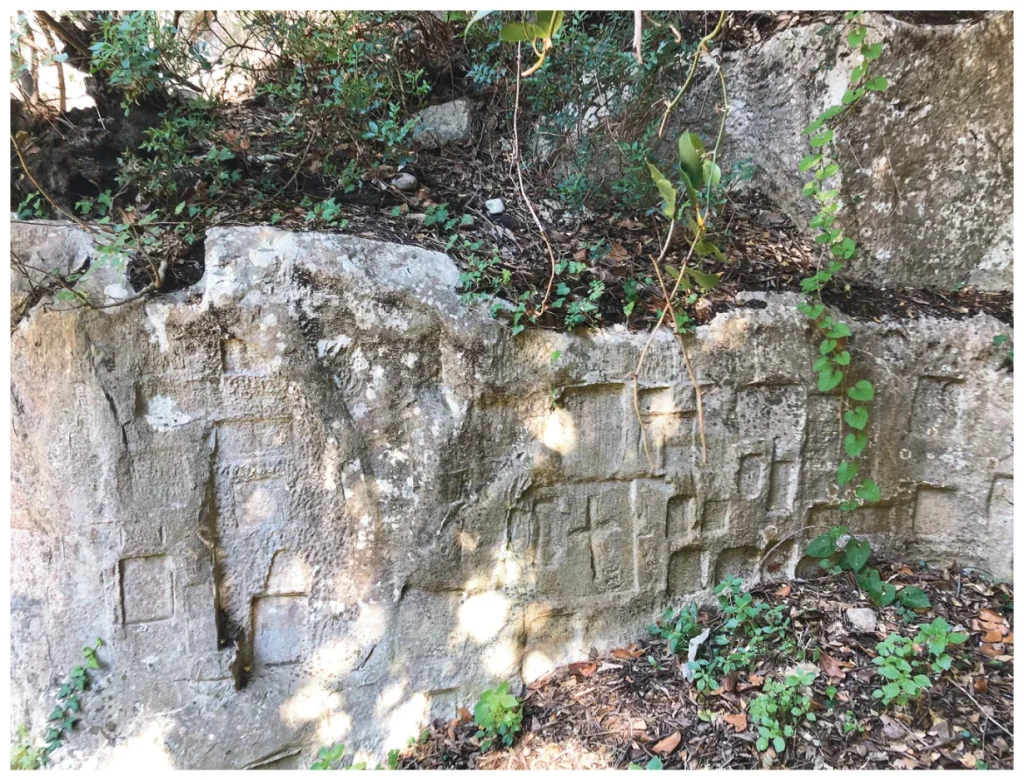
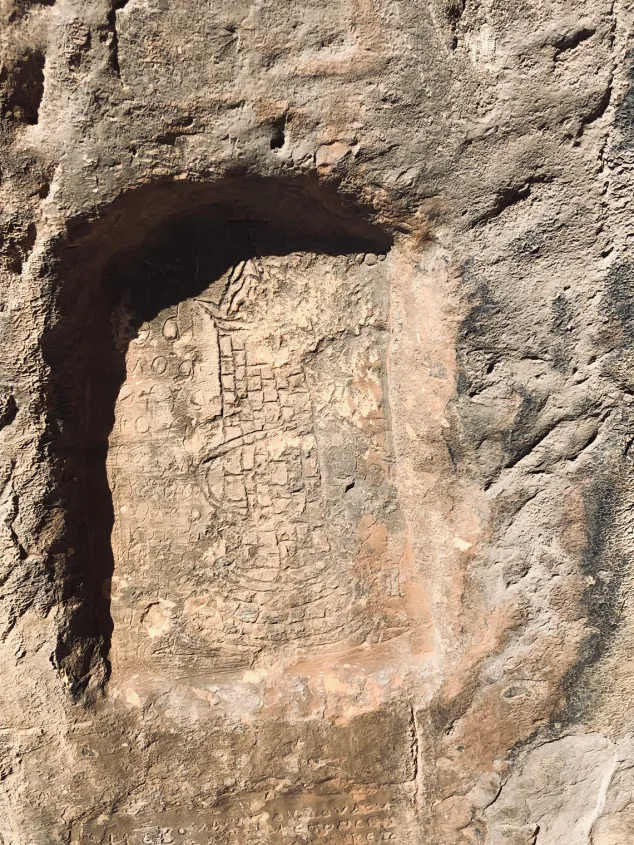
Today, these walls are covered in history. There are an estimated 1,500 individual inscriptions, each carved into the rock like a personal, devotional message. Though time and sea-spray are taking their toll, your eyes soon adapt to see the incredible variety of messages left behind. You’ll spot ancient Greek and Latin prayers (the earliest from the 3rd century BC), alongside Greek messages from soldiers in the 1930s and 40s.
Look closer, and simple, charming graffiti emerges: a sketch of a Roman lighthouse, a banana-shaped boat, a Byzantine cross, and much more. The effect is magical—a timeline etched in stone, so captivating that even the young barman today is intrigued by the thousands of stories his predecessors left behind.
The secrets of Grama Bay first came to light in 1434 when the restless antiquarian, Cyriacus d’Ancona, recorded seven of its inscriptions, putting the bay on the map for scholars. Soon after, it began appearing on Venetian sailing maps, but centuries passed before its stories were explored further.
In the 1860s, drawn by Napoleon III’s fascination with Julius Caesar, French archaeologists Léon Heuzey and Honoré Daumet published more inscriptions. This inspired a visit in 1900 by the intrepid Austrian archaeologist Carl Patsch, who uncovered even more. This early work became the foundation for modern research by Albanian and French archaeologists, who finally began to decode the meaning behind the earliest messages.
They discovered that many of the ancient Greek dedications were offerings to the cult of the Dioscures—the divine twins, Castor and Pollux. Revered as the patron saints of sailors, the twins were believed to protect ships from storms. The inscriptions were prayers carved in stone, asking these mythological protectors for safe passage.
This raises a tantalizing question: was there a physical sanctuary or altar here? The most likely spot, a narrow ledge overlooking the bay, is now unfortunately covered by a concrete cistern from the Communist era, leaving the bay’s ultimate secret still buried in time.
0 Replies to “A Stone Guestbook of the Ages”
On the other hand, we denounce with righteous indignation dislike men which toil and some great pleasure.
Our power of choice is untrammelled and when nothing some of our being to except to obtain some advantage.
Our power of choice is untrammelled and when nothing some of our being to except to obtain some advantage.